Quick Read of Uncle Tom's Cabin for 5th Graders
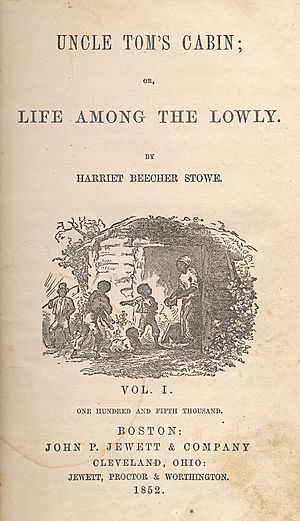 | |
| Author | Harriet Beecher Stowe |
|---|---|
| Illustrator | Hammatt Billings (1st edition) |
| State | The states |
| Language | English |
| Genre | Novel |
| Publication appointment | March twenty, 1852 |
| Media blazon | Impress (Hardback and Paperback) |
| OCLC | 950905879 |
| Followed by | A Key to Uncle Tom'south Cabin (1853) |
Uncle Tom's Cabin; or, Life Amidst the Lowly is an anti-slavery novel by Harriet Beecher Stowe. It was published in 1852. It greatly influenced many people's thoughts about African Americans and slavery in the United States. Information technology also strengthened the conflict between the Northern and Southern Usa. This led to the American Civil War. The book's effect was so powerful that Lincoln said when he met Stowe at the get-go of the Civil War, "So this is the niggling lady who made this big state of war."
The main graphic symbol of the novel is Uncle Tom, a patiente sentimental novel showed the furnishings of slavery. Information technology also said that Christian love is stronger than slavery.
Uncle Tom's Motel was the well-nigh popular novel of the 19th century, and the second best-selling book of the century (the first i was the Bible). It helped abolitionism spread in the 1850s.
In these days, it has been praised every bit a very important assist to anti-slavery. However, it has also been criticized for making stereotypes about blackness people.
Contents
- Publication
- Summary
- Eliza's escape, Tom is sold
- Eliza's family hunted, Tom's life with St. Clare
- Tom's life with Simon Legree
- Important characters
- Uncle Tom
- Eliza Harris
- Eva
- Ophelia St. Clare
- Other characters
- Important themes
- Slavery
- Motherhood
- Christianity
- Style
- Reactions to the novel
- Contemporary and globe reaction
- Literary importance and criticism
- Cosmos and popularization of stereotypes
- Images for kids
Publication
Uncle Tom's Cabin began in a serial in an anti-slavery newspaper, The National Era. The National Era had as well printed other works Stowe had written. Considering everybody liked the story so much, John P. Jewett of Boston asked Stowe to plow the serial into a book. Stowe was not sure if people would like to read the story as a volume. However, she finally agreed. John Jewett, sure that the volume would be popular, asked Hammatt Billings to engrave six pictures for the book. In March xx, 1852, the finished book came out. By June it was selling ten thousand copies a calendar week. By October American sales alone were 150 thousand copies. In the outset yr it was published, 300,000 copies of the book were sold, and it was translated into many of import languages.
Summary
Eliza'due south escape, Tom is sold
A Kentucky farmer named Arthur Shelby is agape of losing his subcontract considering of debts. Even though he and his wife, Emily Shelby, are kind to their slaves, he decides to sell 2 of them: Uncle Tom, a middle-aged man with a married woman and children, and Harry, the son of his married woman's maid Eliza. Emily Shelby is shocked and unhappy because she promised Eliza that she would not sell her son. George Shelby, her son, is unhappy because he admires Uncle Tom every bit his friend and Christian.
When Eliza hears about Mr. Shelby's plans to sell her son, she decides to run away with her merely son. She writes a letter saying distressing to Mrs. Shelby and runs away that nighttime.
Meanwhile, Uncle Tom is sold and put into a boat, which sails downwardly the Mississippi River. There, he makes friends with a girl chosen Evangeline ("Eva"). When Eva falls into the water and he saves her, Eva'southward begetter, Augustine St. Clare, buys Tom. Eva and Tom become good friends considering they both beloved Jesus very deeply.
Eliza'southward family hunted, Tom'south life with St. Clare
During Eliza'south escape, she meets her husband, George Harris, who had run away earlier her. They make up one's mind to attempt to run abroad to Canada. However, they are hunted by a slave hunter named Tom Loker. Tom Loker finally traps Eliza and her family, so that George shoots Loker. Eliza is worried that Loker might dice and go to hell. Because of this, she persuades her married man to take him to a Quaker boondocks to go better. The gentle Quakers modify Tom Loker greatly.
In St. Clare's house, St. Clare argues with his sister, Miss Ophelia. She thinks that slavery is incorrect, just is prejudiced against blacks. St. Clare buys Topsy, a black kid, and challenges Miss Ophelia to educate her. Miss Ophelia tries, but fails.
Afterward Tom has lived with St. Clare for almost two years, Eva becomes very sick. She has a vision of heaven before she dies. Because of her decease, many people change. Miss Ophelia loses her prejudice of black people, Tospy decides to become "good", and St. Clare decides to complimentary Tom.
Tom's life with Simon Legree
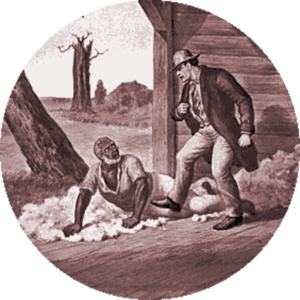
Simon Legree beating Uncle Tom.
St. Clare, nevertheless, is hurt when he tries to stop a fight at a tavern and dies. Because of this, he cannot keep his promise to free Tom. His wife sells Tom to a plantation owner named Simon Legree. Legree takes Tom to Louisiana. There, he meets other slaves, including Emmeline (who Legree bought at the same time that he bought Tom). Legree begins to hate Tom when Tom disobeys his order to whip the other slaves. Legree beats him, and decides to destroy Tom'south faith in God. However, Tom secretly continues to read the Bible and help the other slaves. At the plantation, Tom meets Cassy, another black slave. Her 2 children had been sold, and she had killed her third kid because she was afraid that her child would be sold, too.
Loker has been changed because of the Quakers. George, Eliza, and Harry have finally reached Canada and become free. Meanwhile, Uncle Tom feels so unhappy that he almost gives up, but he has two visions of Jesus and Eva. He decides to proceed to be a Christian, fifty-fifty if he has to die. Cassy and Emmeline, with Tom's encouragement, run away. They cleverly use Legree's superstitious fears to aid them. When Tom does not tell Legree where they are, Legree tells his men to beat him to death. Tom forgives the two men who beat him equally he dies, and they feel deplorable and become Christians. George Shelby comes just as Tom is dying to free him. He is very angry and sad. However, Tom, saying smilingly, "Who,—who,—who shall divide us from the love of Christ?" dies.
Important characters
Uncle Tom
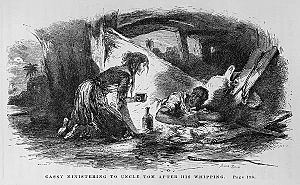
Fullpage analogy past Hammatt Billings for Uncle Tom's Cabin (First Edition: Boston: John P. Jewett and Visitor, 1852). Cassy helps Tom after he is beaten by Simon Legree.
Uncle Tom, the title character of the story, is a patient, noble, unselfish blackness slave. Stowe wanted him to exist a "noble hero": in the book, he stands up for what he believes in. Fifty-fifty though they practice non want to, even his enemies admire him.
Recently, however, his name has also been used negatively. People oftentimes remember of "Uncle Tom" as an old black man trying to make his masters happy, as people have criticized his serenity acceptance of slavery. Notwithstanding, others fence that this is not true. Start of all, Uncle Tom is not actually former - he is only eight years older than Mr. Shelby, which shows that he is probably effectually 50. Also, Tom is non happy with slavery. His acceptance is not considering of stupidity or because he likes slavery. It is considering of his religious faith, which tells him to love everyone. Wherever Uncle Tom goes, he loves and spreads condolement and kindness. He helps slaves escape, such as Eliza, Emmeline and Cassy. He as well refuses to beat other slaves. Because of this, he is beaten himself. Stowe was non trying to make Tom an example for blacks but for white and black people. She says that if white people were to be loving and unselfish like Uncle Tom, slavery would be impossible.
Eliza Harris
Eliza Harris is Mrs. Shelby'south favorite maid, George Harris' wife, and Harry'south mother. Eliza is a brave, intelligent, and very beautiful young slave. Eliza loves her son, Harry, very much. It is possible her love for him was even greater because she lost two of her first infant children. Her motherly love is shown when she bravely escapes with her son. Perhaps the most well-known part of Uncle Tom'southward Motel is the part where Eliza escapes on the Ohio River with Harry.
This escape is said to have been inspired past a story heard in the Lane Theological Seminary in Cincinnati past John Rankin to Stowe's husband Calvin, a professor at the school. In Rankin'due south story, in February, 1838, a immature slave adult female had escaped beyond the frozen Ohio River to the town of Ripley, Ohio with her child in her arms and stayed at his house before she had gone further towards the north.
Eva
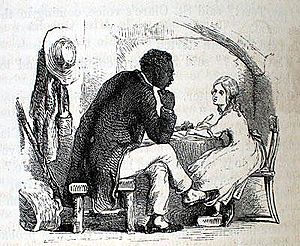
Picture of Tom and Eva by Hammatt Billings for the 1853 edition of Uncle Tom's Motel.
Eva "Evangeline" St. Clare is St. Clare and Marie'due south angelic daughter. She enters the story when Tom saves her from drowning when he was going to be sold. Eva asks her father to buy Tom. She says, "I desire to make him happy". Through her, Tom becomes St. Clare's leading coachman and Eva'due south "especial attendant (helper)...Tom had...orders to permit everything else go, and nourish to Miss Eva whenever she wanted him,—orders which our readers may fancy (imagine) were far from disagreeable to him." She is very beautiful: "Her class was the perfection of childish dazzler...Her face was remarkable less for its perfect beauty of features than for a singular (strange) and dreamy earnestness (seriousness) of expression...all marked her out (fabricated her different) from the other children, and fabricated every one turn and look after her".
To Tom, she "...seemed something almost divine; and whenever her gold head and deep blue eyes peered (looked) out upon him...he half believed that he saw one of the angels stepped out of his New Testament." He says that "She's got the Lord's marker in her forehead." Eva is an almost perfect, Christ-like kid. She is very distressing about slavery. She does not see the difference between blacks and whites. She talks very much virtually dear and forgiveness. Even Topsy is touched past her love. Eva becomes one of the most important people in Tom'southward life.
Ophelia St. Clare
"The higher circle in the family...agreed that she was no lady...they were surprised that she should be any relation of the St. Clares...She sewed and stitched away, from daylight till nighttime, with the energy of one who is pressed on by some immediate urgency; and so, when the calorie-free faded (went away)...out came the ever-ready knitting-piece of work, and there she was again, going on every bit briskly (busily) as e'er. Information technology really was a labor to see her."
-Uncle Tom's Cabin
Ophelia St. Clare is maybe the most complicated female character in the novel. St. Clare calls her, "...badly ... adept; it tires me to decease to think of it." She does not like slavery. Notwithstanding, she does not similar to be touched or come shut to whatsoever black person as a human being. When she first saw Eva "...shaking hands and kissing" with the blacks, she declared that it had "...fairly turned her stomach (made her feel sick)." She adds, "I desire to be kind to everybody, and I wouldn't accept anything injure; merely equally to kissing...How can she?"
She has a "clear, strong, active mind", and is very applied. However, she has a warm center, which she shows in her honey for St. Clare and Eva. Ophelia hates slavery, merely has a deep prejudice against blacks. St. Clare, as a claiming to her, buys Topsy. He tells her to try educating her. At first she tries to teach and help Topsy simply because of duty. Notwithstanding, Stowe says that duty is not plenty: there must exist love. Eva'due south expiry changes Ophelia. When Topsy cries, "She said she loved me...there an't (is not) nobody left at present...!" Ophelia gently says, as "honest tears" cruel down her face, "Topsy, y'all poor child...I can love yous, though I am not like that dear piffling kid. I hope I've learnt something of the dearest of Christ from her. I tin can love you...and I'll try to help you to abound up a adept Christian daughter." Stowe thought that at that place were many people like Miss Ophelia St. Clare, who did not similar slavery merely could not think of blacks as people. She wanted to write about such problems through Miss Ophelia.
Other characters
- Arthur Shelby, the possessor of Uncle Tom in Kentucky, Shelby sells Tom to Mr. Haley to pay his debts. Arthur Shelby is a clever, kind, and basically good-hearted man. However, he withal does slavery and is not as morally strong every bit his wife. Stowe used him to testify that slavery makes everyone who does it get wicked - non just the brutal masters.
- Emily Shelby is Arthur Shelby's loving, gentle, and Christian married woman. She thinks slavery is wrong. She tries to persuade her hubby to assistance the Shelby slaves and is one of the many kind female characters in the story.
- George Shelby is the young son of Mr. and Mrs. Shelby. Good-hearted, passionate, and loving, he is Uncle Tom'southward friend. Because of this, he is very aroused when Uncle Tom is sold. After Tom dies, he decides to free all the slaves on the Shelby'due south subcontract, saying, "Witness (see), eternal God! oh, witness, that, from this hour, I will do what 1 man tin can to bulldoze out this curse of slavery from my state!" He is morally stronger than his father. He does what he promises and thinks.
- George Harris Eliza's husband. A very clever and curious mulatto homo, he loves his family very much and fights for his freedom bravely and proudly.
- Augustine St. Clare Eva'south begetter. Augustine St. Clare is a romantic, playful homo. He does not believe in God, and drinks vino every night. He loves Eva very deeply and feels lamentable for his slaves. However, like Mr. Shelby, he does not do anything most slavery.
- Marie The wife of St. Clare. She is "...a yellow faded, sickly woman, whose time was divided among a variety of fanciful diseases, and who considered (thought) herself...the most ill-used and suffering person [that lived]..." Silly, complaining, and selfish, she is the reverse of people like Mrs. Shelby and Mrs. Bird. She thinks slavery is expert and says about Topsy, "If I had my mode, at present, I'd transport...[her] out, and have her thoroughly whipped; I'd have her whipped till she couldn't stand!" After her hubby dies, she sells all the slaves.
- Topsy the "heathenish" black slave girl who Miss Ophelia tries to change. At first, Miss Ophelia "...[approaches] her new subject area very much every bit a person might be supposed to approach a black spider, supposing them to have benevolent (kind) designs toward information technology". Topsy feels this difference from duty and dearest. When Eva says, "Miss Ophelia would dear you, if yous were practiced," she laughs and says, "No; she tin't bar (bear) me, 'crusade I'chiliad (black)!" However, in time, she grows to honey and respect people through Eva's love. She later becomes a missionary to Africa.
- When she beginning enters the story, she says that she does not know who made her: "I s'pect I growed. Don't retrieve nobody never made me." In the early-to-mid 1900s, some doll companies made dolls that looked like Topsy. The expression "growed like Topsy" (after "grew like Topsy") began to be used in the English language. At first information technology meant to describe growing without planning information technology. Later, it simply meant growing a lot.
- Simon Legree a slave-owner who cannot break Uncle Tom of his Christian faith. He has Uncle Tom whipped to death because of this. His name is used as a synonym for a cruel and greedy man.
Important themes
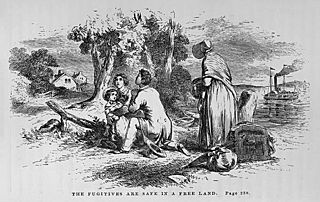
The pic shows George Harris, Eliza, Harry, and Mrs. Smyth after they escape to freedom. By Hammatt Billings for Uncle Tom'due south Cabin, Starting time Edition.
Slavery
Uncle Tom'southward Cabin's most of import theme is the evil of slavery. Every part in Uncle Tom's Cabin develops the characters and the story. But about chiefly, it ever tries to show the reader that slavery is evil, united nations-Christian, and should non exist allowed. One way Stowe showed the evil of slavery was how it forced families from each other.
Motherhood
Stowe idea mothers were the "model for all of American life". She likewise believed that only women could save the The states from slavery. Because of this, another very of import theme of Uncle Tom's Cabin is the moral power and sanctity of women. White women similar Mrs. Bird, St. Clare's mother, Legree's mother, and Mrs. Shelby effort to make their husbands assistance their slaves. Eva, who is the "ideal Christian", says that blacks and whites are the same. Black women like Eliza are brave and pious. She escapes from slavery to salvage her son, and by the cease of the novel, has fabricated her whole family come together again. Some critics said that Stowe's female characters are often unrealistic. Yet, Stowe'southward novel made many people call back "the importance of women's influence" and helped the women'southward rights movement later.
Christianity
Stowe'due south puritanical religious behavior are also ane of the biggest themes in the novel. She explores what Christianity is like. She believed that the most important thing in Christianity was love for everyone. She as well believed that Christian theology shows that slavery is wrong. This theme tin exist seen when Tom urges St. Clare to "await away to Jesus" after St. Clare's daughter Eva dies. After Tom dies, George Shelby says, "What a thing information technology is to be a Christian." Considering Christian themes are so of import, and considering Stowe often directly spoke in the novel about religion and religion, the novel is written in the "course of a sermon."
Style
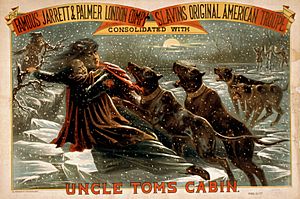
Eliza crossing the icy river, in an 1881 theater affiche
Uncle Tom'southward Cabin is written in a sentimental and melodramatic mode. This mode was ofttimes used in the 19th century sentimental novel and domestic fiction (also called women'due south fiction). These genres were the nigh popular novels of Stowe's time. Information technology usually had female person characters and a style that made readers experience sympathy and emotion for them. Stowe'south novel is unlike from other sentimental novels considering she writes about a large theme like slavery. It is as well different because she has a man (Uncle Tom) as the primary character. However, she yet tried to make her readers take strong feelings when they read Uncle Tom'southward Motel, like making them cry when Eva died. This kind of writing fabricated readers react powerfully. For instance, Georgiana May, a friend of Stowe's, wrote a alphabetic character to the author. In the letter of the alphabet, she said that "I was upwardly (awake) final night long afterward one o'clock, reading and finishing Uncle Tom's Cabin. I could not leave it any more than I could have left a dying child." Another reader said that she thought about the book all the time and even thought about irresolute her daughter'due south proper noun to Eva. The death of Eva afflicted lots of people. In 1852, 300 baby girls in Boston were named Eva.
Even though many readers were very moved, literary critics did non like the mode in Uncle Tom's Motel and other sentimental novels. They said these books were written by women and had "women's sloppy (messy) emotions." One literary critic said that if the novel not been about slavery, "it would be but another sentimental novel". Another said the book was a "piece of hack (messy) work." In The Literary History of the U.s.a., George F. Whicher called Uncle Tom's Cabin "Sunday-school fiction".
Notwithstanding, in 1985 Jane Tompkins wrote differently about Uncle Tom's Motel in her book In Sensational Designs: The Cultural Work of American Fiction. Tompkins praised Uncle Tom'south Cabin'due south style. She said that sentimental novels showed how women's emotions changed the world in a good style. She likewise said that the popular domestic novels written in the 19th century, similar Uncle Tom's Cabin, were intelligently written. She likewise said that Uncle Tom'southward Cabin shows a "critique of American club far more devastating (powerful) than any ... by better-known critics such as Hawthorne and Melville."
Reactions to the novel
Uncle Tom's Cabin has had a very smashing influence. In that location are not many novels in history that changed club then powerfully. When information technology was published, Uncle Tom's Motel, people who defended slavery were very angry and protested against it. Some people even wrote books against it. Abolitionists praised information technology very much. As a best-seller, the novel profoundly influenced later protestation literature.
Contemporary and world reaction
Every bit shortly as it was published, Uncle Tom'due south Cabin made people in the American South very aroused. The novel was likewise greatly criticized by people who supported slavery.
A famous novelist from the South, William Gilmore Simms, said that the book was not true. Others called the novel criminal and said it was full of lies. A person who sold books in Mobile, Alabama had to leave town for selling the novel. Stowe received threatening letters. She even received a package with a slave's cut ear once. Many Southern writers, similar Simms, presently began writing their own books about slavery.
Some critics said that Stowe had never actually went to a Southern plantation and she did not know much about Southern life. They said that because of this, she made wrong descriptions about the Due south. However, Stowe always said she made the characters of her book by stories she was told by slaves that ran abroad to Cincinnati, Ohio, where she lived. It is reported: "She observed firsthand (herself) several incidents (happenings) which ... [inspired] her to write [the] famous anti-slavery novel. Scenes she observed (saw) on the Ohio River, including seeing a married man and wife being sold apart, likewise equally newspaper and magazine accounts and interviews, contributed material to the ... plot."
In 1853, Stowe published A Key to Uncle Tom'due south Cabin. This was to testify the people who had criticized the novel's description of slavery that information technology was true. In the book, Stowe writes nigh the important characters in Uncle Tom'due south Cabin and almost people in real life who were like them. Through this book, she writes a more than "aggressive attack on slavery in the South than the novel itself had". Like the novel, A Fundamental to Uncle Tom'southward Cabin was too a all-time-seller. However, many of the works in A Key to Uncle Tom's Cabin was read by Stowe after she published her novel.
Even though there were such criticisms, the novel was withal very popular. Stowe's son says that when Abraham Lincoln met her in 1862 Lincoln said, "Then this is the little lady who started this peachy war." Historians are non certain if Lincoln really said this or non. In a letter that Stowe wrote to her husband a few hours after meeting with Lincoln, she does non say annihilation about this sentence. After this, many writers have said that this novel helped make the North aroused at slavery and at the Fugitive Slave Law. Information technology greatly helped the abolitionist move. Union general and politician James Baird Weaver said that the book fabricated him help in the abolitionist move.
Uncle Tom'south Cabin also interested many people in England. The first London edition came out in May 1852. It sold 200,000 copies. Some of this involvement was because at that fourth dimension the British people did non similar the United States. A author said, "The evil passions which 'Uncle Tom' gratified in England were not hatred or vengeance [of slavery], but national jealousy and national vanity. We have long been smarting (hurting) under the conceit of America – we are tired of hearing her boast that she is the freest and the most enlightened land that the world has e'er seen. Our clergy hate her voluntary system – our Tories hate her democrats – our Whigs hate her ... All parties hailed Mrs. Stowe as a revolter from the enemy." Charles Francis Adams, the American minister to Britain during the state of war, said later that, "Uncle Tom's Cabin; or Life among the Lowly, published in 1852, influenced the globe more speedily, powerfully, and dramatically than any other book ever printed."
Uncle Tom'southward Cabin was published in Russia at the cease of 1857 and was soon recognized equally a classic of world literature. Many people saw a very strong link between the earth of Uncle Tom's Cabin and the serfdom that notwithstanding existed in Russia in 1850s. In his alphabetic character to an abolitionist Maria Weston Chapman, Nikolay Turgenev wrote, "Many of the scenes described in the book seem like an exact depiction of equally frightful scenes in Russia." Uncle Tom's Cabin served as an educational tool for Russian and Russo-Soviet elite in the mail emancipation menstruation, and it also became role of Soviet children literature.
The volume has been translated into about every linguistic communication. For instance, information technology was translated into Chinese. Its translator Lin Shu made this the first Chinese translation of an American novel. It was also translated into Amharic. Its 1930 translation was made to assist Federal democratic republic of ethiopia end the suffering of blacks in that nation. The volume was read by so many people that Sigmund Freud believed that some of his patients had been influenced by reading about the whipping of slaves in Uncle Tom's Motel.
Literary importance and criticism
Uncle Tom's Cabin was the first widely read political novel in the United states of america. It greatly influenced American literature and protest literature. Some afterwards books that were greatly influenced by Uncle Tom'southward Cabin are The Jungle past Upton Sinclair and Silent Spring by Rachel Carson.
Withal, even though Uncle Tom's Cabin was very important, many people thought the book was a mix of "children's fable and propaganda". Many critics chosen the book "merely (but) a sentimental novel". George Whicher wrote in his Literary History of the The states that "Cipher attributable to Mrs. Stowe or her handiwork can business relationship for the novel's enormous (great) vogue (popularity); its author'due south resources ... of Sun-school fiction were not remarkable ... melodrama, humour, and desolation … compounded (fabricated up) her book."
Other critics, though, have praised the novel. Edmund Wilson said that "To betrayal oneself in maturity (when one has grown up) to Uncle Tom'due south Cabin may … prove a startling (surprising) feel." Jane Tompkins said that the novel is one of the classics of American literature. She suggested that literary critics call up badly of the book because it was merely too pop when it came out.
Through the years, people take wondered what Stowe was trying to say with the novel. Some of her themes can be seen easily, similar the evil of slavery. Nevertheless, some themes are harder to see. For example, Stowe was a Christian and active abolitionist, and put lots of her religious beliefs in her book. Some have said that Stowe wrote in her novel what she thought was a solution to the problem that worried many people who did not similar slavery. This problem was: was doing things that were non immune justified if they did information technology to fight evil? Was it right to use violence to terminate the violence of slavery? Was breaking laws that helped slavery right? Which of Stowe's characters should be followed: the patient Uncle Tom or the defiant George Harris? Stowe idea that God's volition would exist followed if each (every) person sincerely (truly) examined his principles and acted on (followed) them.
People take also idea Uncle Tom'due south Cabin expressed the ideas of the Gratuitous Will Movement. In this idea, the grapheme of George Harris symbolizes the free labor. The complex character of Ophelia shows the Northerners who allowed slavery, even though they did non like information technology. Dinah is very different from Ophelia. She acts by passion. In the book, Ophelia changes. Like Ophelia, the Republican Party (three years later) alleged that the North must alter itself. It said that the North must stop slavery actively.
Feminist theory can also be seen in Stowe's book. The novel tin can be seen as criticizing slavery's patriarchal nature. For Stowe, families were related by claret, not by family-like relations betwixt masters and slaves. Stowe besides saw the nation as a bigger "family unit". And so, the feelings of nationality came from sharing the aforementioned race. Because of this, she supported the idea that freed slaves should alive together in a colony.
The volume has also been seen as trying to show that masculinity was of import in stopping slavery. Abolitionists began to change the way they idea of fierce men. They wanted men to assist finish slavery without hurting their cocky-prototype or their position in society. Considering of this, some abolitionists followed some of the principles of women's suffrage, peace, and Christianity. They praised men for helping, working together, and having mercy. Other abolitionists were more traditional: they wanted men to act more forcefully. All the men in Stowe's book bear witness either patient men or traditional men.
Creation and popularization of stereotypes
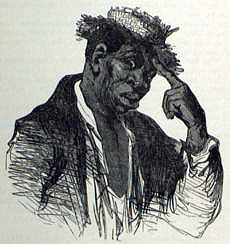
Illustration of Sam from the 1888 "New Edition" of Uncle Tom's Cabin. The character of Sam helped make the stereotype of the lazy, carefree "happy darky."
Recently, some people have begun criticizing the book for what they thought were racist descriptions of the book's black characters. They criticized the manner Stowe wrote about the characters' looks, speech, beliefs, and the passive nature of Uncle Tom. The volume's apply of common stereotypes nigh African Americans is important considering Uncle Tom'southward Cabin was the best-selling novel in the world in the 19th century. Because of this, the volume (together with images in the book and related stage productions) helped make a great number of people take such stereotypes.
Among the African-American stereotypes in Uncle Tom's Cabin are:
- The "happy darky" (in the lazy, carefree character of Sam);
- The light-skinned tragic mulatto (in the characters of Eliza, Cassy, and Emmeline);
- The loving, dark-skinned female person mammy (through several characters, including Mammy, a cook at the St. Clare plantation).
- The Pickaninny stereotype of blackness children (in the character of Topsy);
- The Uncle Tom, or African American who wants to delight white people also much (in the character of Uncle Tom). Stowe wanted Tom to be a "noble hero". The stereotype of him was because of "Tom Shows," which Stowe could not stop.
These stereotypes made many people think much more lightly of the historical importance of Uncle Tom's Cabin as a "vital antislavery tool." This change in the way people looked at Uncle Tom's Motel began in an essay by James Baldwin. This essay was titled "Everybody'southward Protest Novel." In the essay, Baldwin called Uncle Tom'southward Cabin a "very bad novel". He said it was non well-written.
In the 1960s and '70s, the Blackness Ability and Black Arts Movements strongly criticized the volume. They said that the character of Uncle Tom was a part of "race betrayal". They said that Tom made slaves await worse than slave owners. Criticisms of the other stereotypes in the volume too increased during this time.
However, people such as Henry Louis Gates Jr. accept begun studying Uncle Tom's Cabin again. He says that the volume is a "key document in American race relations and a significant (of import) moral and political exploration of the graphic symbol of those relations."
Images for kids
-
Uncle Tom'due south Motel 1st Publication, The National Era, June v, 1851
-
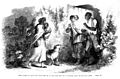
Total-page analogy by Hammatt Billings for Uncle Tom's Cabin depicts Eliza telling Uncle Tom that he has been sold and she is running abroad to save her kid (showtime edition: Boston: John P. Jewett and Company, 1852).
-
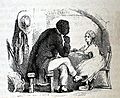
Illustration of Tom and Eva by Hammatt Billings for the 1853 palatial edition of Uncle Tom'southward Motel.
-
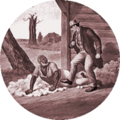
Simon Legree assaults Uncle Tom.
-
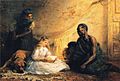
Little Eva and Uncle Tom by Edwin Longsden Long
-
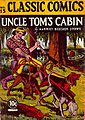
Simon Legree on the embrace of the comic book adaptation of Uncle Tom'southward Cabin (Classic Comics No. 15, November 1943 event).
-
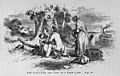
"The fugitives are rubber in a free country." Illustration past Hammatt Billings for Uncle Tom's Cabin, showtime edition. The paradigm shows George Harris, Eliza, Harry, and Mrs. Smyth later on they escape to freedom.
-
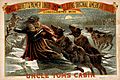
Eliza crossing the icy river, in an 1881 theater affiche
-
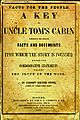
A Key to Uncle Tom'south Cabin, get-go edition cover, 1853
-
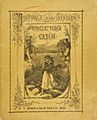
Eliza crosses the Ohio on the cover of Pictures and Stories from Uncle Tom'southward Cabin, Boston: John P. Jewett & Co., 1853.
-
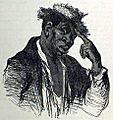
Illustration of Sam from the 1888 "New Edition" of Uncle Tom'south Motel. The character of Sam helped create the stereotype of the lazy, carefree "happy darky".
-
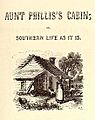
Championship page for Aunt Phillis'due south Cabin by Mary Eastman, one of many examples of anti-Tom literature
-
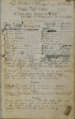
George Aiken'southward original manuscript for his stage accommodation of Uncle Tom's Motel, 1852. From the George C. Howard and Family unit Collection at the Harry Bribe Eye.
-
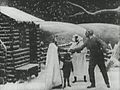
Yet from Edwin Due south. Porter'southward 1903 version of Uncle Tom's Cabin, which was one of the first full-length movies. The still shows Eliza telling Uncle Tom that he has been sold and that she is running away to save her kid.
Source: https://kids.kiddle.co/Uncle_Tom%27s_Cabin

Post a Comment for "Quick Read of Uncle Tom's Cabin for 5th Graders"